


American Mud Pumps
Power End Bearing Systems


Engineered for its Designed Intent and Application
Purpose-built for the power end of the reciprocating mud pump.
A catalog bearing is engineered to do one thing well: fit as many machines as possible. That is sound engineering. It is also the wrong intent for a mud pump power end.
American Mud Pumps® engineers to a different intent. Every bearing is built for one machine, one position, one duty, the reciprocating mud pump, and its exact place inside it. Specified for that job from the start, qualified to our own standard, and accountable to the application it was designed for.
Engineered by Experts
The People Behind the Design
A design intent has to come from someone who has earned it. American Mud Pumps® has spent decades doing one thing: designing, building, and overhauling reciprocating mud pumps.
That is where our bearing standard comes from, not a catalog, but generations of engineers who have torn these pumps down, seen how the loads move and where they concentrate, and built that knowledge back into every DeepRun™ bearing.

Why Bearings Fail Early,
And Why It's Hard to See Coming
Every stroke reverses the load through the crankshaft, connecting rods, and pinion shaft thousands of times an hour, in some of the harshest environments on earth. Most premature failures trace to four root causes, which usually compound:
-
Contamination & lubrication breakdown: mud, water, and abrasives past worn seals destroy the oil film and score raceways.
-
Fatigue & spalling: the pulsating, reversing load drives subsurface cracking, accelerated by overload.
-
Installation & clearance error: incorrect preload or shimming guesswork builds a short life into the pump before it turns.
-
Substandard bearing quality: dirty steel, inconsistent heat treat, and loose tolerances no field crew can compensate for.
The last is the most dangerous, because it's invisible at receiving and unpredictable in service. A cheap bearing looks identical, then fails at a fraction of its rated life. That's the failure mode a spec sheet can't answer, and a catalog supplier can't defend against.

The Weak Link We Refused to Accept
Spend a lifetime tearing down power ends, and a pattern becomes impossible to ignore. The crankshaft is usually sound. The gears are usually serviceable. The frame outlives everything.
The bearings are almost always what ends a pump's run early. They pull rigs offline, wear housing out of tolerance, and turn scheduled service into an emergency.
So we made a decision: stop treating the bearing as a commodity to be sourced, and start treating it as a system to be engineered and specified for the application by the people who understand the whole pump. That system is DeepRun™


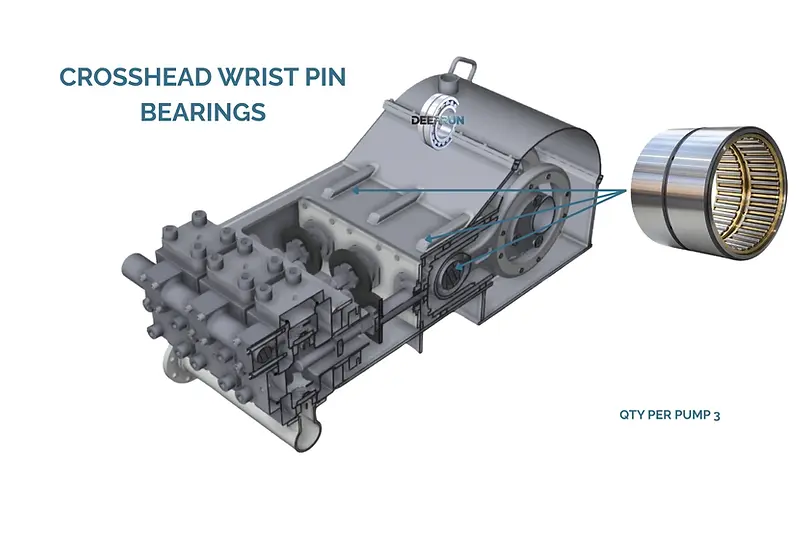

The DeepRun™ Power-End Bearing Lineup
Engineered for the application, position by position


ENGINEERING FEATURES & PERFORMANCE BENEFITS
Each engineering feature maps directly to the outcome the operator experiences in the field.
ENGINEERING FEATURE | WHAT IT DELIVERS | PERFORMANCE BENEFIT |
|---|---|---|
Premium Material Selection | Premium alloy steel with precision heattreatment for strength, wear resistance, and dimensional stability under extreme cyclic load | Longer service life, resists fatigue and wear under continuous cyclic loading. |
Precision Manufacturing | Machined to exact tolerances for consistent fit, balanced load distribution, and reduced vibration. | Greater reliability, consistent tolerances support dependable performance across the service life. |
Advanced Lubrication Engineering | Lubrication pathways that promote continuous oil flow, carry heat away, reduce friction, and extend service intervals.
| Improved heat management removes heat and maintains consistent operating temperatures. |
Integrated Anti-Rotation Design | Prevents housing wear and improves stability under the high-vibration conditions of demanding drilling. | Reduced downtime; minimizes unexpected bearing-related shutdowns and repeat failures.
|
Combined Result | Longer service intervals and reduced maintenance across the life of the pump. | Lower total cost of ownership lifecycle cost, not just purchase price. |
Disclaimer & Confidentiality: For informational purposes only; performance depends on application, operating conditions, cleanliness, and maintenance, and results may vary. Bearing life references reflect ISO 281methodology and AMP-published data, not guaranteed performance of any specific product. Bearing types and configurations vary by pump model — confirm against the applicable OEM parts manual. Patents referencedidentify their named inventors and remain the property of their respective assignees; their mention reflects the engineering credentials of AMP's design team, not a claim that any AMP product is patented.
Whether it's extending service intervals, preventing bearing-related shutdowns, or lowering total cost of ownership, DeepRun is the system you trust when the power end can't afford a weak link.
Engineered for the Long Run.
FAQ — Power-End Bearing Systems
What are power-end bearings on a mud pump?
Power-end bearings are the load-bearing components inside a reciprocating mud pump's power end that support the crankshaft, connecting rods, pinion shaft, and crosshead assembly. They absorb the reversing mechanical loads generated on every stroke and transfer them into the pump housing without excess friction or play.
Why do mud pump bearings fail early?
Most premature bearing failures come from four compounding causes: contamination and lubrication breakdown, fatigue and spalling from reversing loads, incorrect installation or preload, and substandard bearing quality. The last cause is the most dangerous because it's invisible at receiving and only shows up as a shortened service life once the pump is running.
What types of bearings are used in a power end, and where?
A power end uses different bearing types by position: tapered roller bearings (opposed pair) on the pinion/input shaft, spherical or tapered roller bearings on the crankshaft mains, cylindrical roller bearings on the connecting-rod big end/eccentric, and multi-row cylindrical roller bearings on the crosshead wrist pin.
Are DeepRun bearings compatible with my mud pump model?
DeepRun bearings are engineered for a specific machine, position, and duty rather than sized to fit multiple pumps generically. Bearing types and configurations vary by pump model, so compatibility should be confirmed against the applicable OEM parts manual or with an American Mud Pumps® specialist before ordering.
How do I know when a power-end bearing needs to be replaced?
Warning signs include unusual noise or vibration from the power end, visible wear or play in the housing, oil contamination or metal particles in the lubricant, and any drop in pump performance not explained by the fluid end. Because bearing failure often escalates quickly to housing damage (outer-race creep) or a stalled rig, inspection during scheduled power-end overhauls is the safest way to catch it early.